
Direct answer
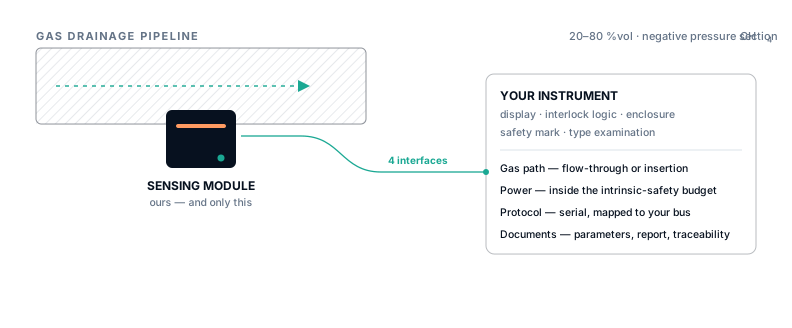
A measurement module supplies evidence to the interlock; it is not the interlock.
At the action point, convert the module accuracy into an absolute band, then add pressure, calibration, drift, sample/location, response and communication contributions. The host system must define setpoint, hysteresis, confirmation time, diagnostic reaction, fail-safe state and final element.
Threshold values are jurisdiction- and position-specific. Do not copy a number from one mining rule into another project without confirming its scope.
1. Separate the measurement, logic and final-action layers
A concentration module detects absorption, calculates a concentration and reports diagnostics. A host controller interprets that result. A final element changes the process—raising an alarm, stopping a pump, closing a valve or rejecting gas. Safety and operational performance depend on all three layers and their interfaces.
| Layer | Owns | Evidence needed |
|---|---|---|
| Measurement module | Optical signal, concentration algorithm, diagnostics and communication output | Accuracy/response tests, pressure and environmental limits, failure states |
| Host instrument / logic | Power, data validation, setpoint, hysteresis, timers, alarm, latching and fault reaction | Software/hardware design, communication supervision and system test |
| Process / final element | Valve, pump, ventilation, utilisation or shutdown action | Cause-and-effect, response time, proof test and applicable mine approval |
2. Turn relative accuracy into an absolute band
For a relative specification ±r at indicated concentration C, a first specification band is C × r. With the current pipeline-module high-segment target of ±3.5% of reading:
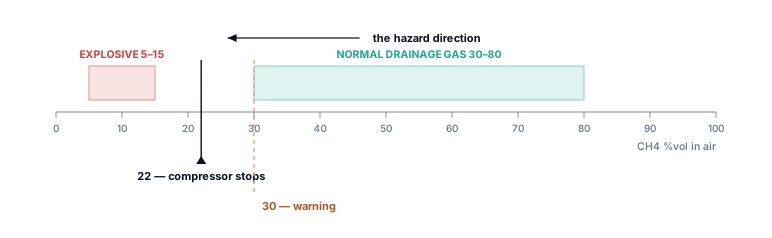
at C = 22 %vol: Uspec = 22 × 0.035 = 0.77 %vol Simple accuracy band: 21.23–22.77 %vol around an indicated 22.00 %vol.
| Relative specification | Absolute half-band | Simple concentration interval |
|---|---|---|
| ±3.5% of reading | ±0.77 %vol | 21.23–22.77 %vol |
| ±4% of reading | ±0.88 %vol | 21.12–22.88 %vol |
| ±5% of reading | ±1.10 %vol | 20.90–23.10 %vol |
| ±6% of reading | ±1.32 %vol | 20.68–23.32 %vol |
The arithmetic makes one fact visible: all four bands cross a threshold at the displayed value. A small improvement in module accuracy does not remove the need for a system policy around the uncertain region.
3. Add the rest of the decision chain
The simple product band is not a measurement-uncertainty calculation. Depending on the project, the system review may include reference-gas uncertainty, calibration fit, drift between calibrations, pressure and temperature compensation, gas matrix, sample or location representativeness, response lag, digital resolution, communication delay and host setpoint implementation.
If contributions are independent and expressed as standard uncertainties, they may be combined by root-sum-square. If only maximum permissible errors are available, the combination method and distribution assumptions must be justified. For a conservative first screening, engineers may compare a worst-case sum, but it should be labelled as such—not called a statistical uncertainty.
4. Keep threshold values attached to their jurisdiction and position
Official German gas-extraction guidance provides a useful example of why scope matters. The guidance distinguishes strong gas at 20% methane or more and gives position-specific actions: it describes measures below 22% at extraction points, a 30% expectation in main or collector lines, a warning below 30% at the pressure generator and automatic shutdown below 22%. These are German, document-specific statements, not universal methane setpoints.
Another country, mine, utilisation process or approved installation can have different values and actions. Before using any threshold, record the issuing authority, document revision, measurement position, averaging/confirmation rule and required action.
5. Validate the cause-and-effect, not only the analyser
- Inject stable gas points below, near and above the action point using a defined reference method.
- Test rising and falling crossings to verify hysteresis and latching.
- Introduce pressure and temperature extremes representative of the measurement point.
- Measure time from gas change at the process boundary to the final element reaching its safe state.
- Simulate optical fault, pressure-sensor fault, stale data, communication loss, out-of-range and power interruption.
- Verify who may reset, bypass or maintain the function and how those states are recorded.
6. Common failure modes
Threshold equals display setpoint
No allowance is made for measurement band, hysteresis, response or final-element travel.
Module design objective becomes system approval
A low-power or intrinsically safe design intent is used as if it certified the host, cable, barrier and installation.
One jurisdiction’s number is globalised
A German position-specific action is copied into another market without checking the governing rules.
Communication fault freezes a plausible value
The host keeps using the last concentration instead of identifying stale data and entering the defined fault state.
7. Minimum project inputs
- Applicable jurisdiction, mine rule, standard, approved design and document revision.
- Exact measurement position and the action associated with each threshold.
- Normal working band, expected crossing rate and acceptable total response time.
- Module accuracy/response evidence under relevant pressure, temperature and gas matrix.
- Host setpoint, hysteresis, confirmation, latching, reset, bypass and communication-fault behaviour.
- Final element, safe state, proof-test method and ownership of system validation.
Primary and official sources
Sources were checked for the specific claims used here. A cited source does not endorse Specval or establish product performance.
- Bezirksregierung Arnsberg: Gasabsauge-Richtlinien — official German gas-extraction guidance containing position-specific methane concentration actions; not a global rule.
- IECEx standards resources — official context for equipment/system explosion-protection standards and certification boundaries.
Technical review date: 30 July 2026.