
Direct answer
Adapt the interfaces and configuration only after the product core and project envelope are fixed.
Gas species, range, optical path, pressure, sampling material, flow, power, protocol, dimensions, environmental protection and documentation can interact. A requested change is acceptable only when its effect on performance, test evidence, approval and manufacturing is reviewed.
If the request changes the operating principle, energy envelope or fundamental mechanical structure, it is new product development—not routine adaptation.
1. Adaptation begins with a stable product core
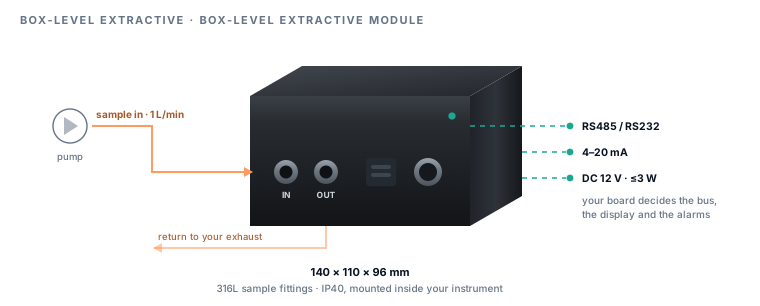
A bounded adaptation changes interfaces or a defined configuration while preserving the validated architecture. Examples include selecting CH₄ instead of CO₂ on the box-level platform, choosing RS485 rather than RS232, adjusting a mounting bracket or preparing a project-specific register map.
A request becomes deeper development when it changes laser/detector technology, optical path architecture, process-contact structure, power topology, intrinsic-safety concept or a new gas with no spectral and material evidence. Calling both activities “customisation” hides schedule, cost and verification consequences.
| Class | Example | Expected review |
|---|---|---|
| Configuration | Approved gas/range option, output scaling or protocol setting | Configuration record and existing evidence applicability |
| Interface adaptation | Connector, mounting, sample fitting or host register mapping | Interface review, targeted verification and drawing revision |
| New development | New gas technology stack, optical path, low-power architecture or process structure | Feasibility, design plan, new evidence and commercial programme |
2. Freeze the inputs that drive configuration
Measurand
Gas species, full range, normal band, decision points, background and interferents.
Gas path
Direct or extractive, pressure, temperature, flow, moisture, dust, wetted materials and response.
Mechanical
Envelope, fitting, mounting, insertion, sealing, orientation, access and host clearances.
Electrical
Supply tolerance, available power, grounding, isolation, connector and protection.
Protocol
Physical layer, message/register map, units, scaling, timing, diagnostics and update rate.
Evidence
Target market, applicable standard, test matrix, document language, acceptance and change control.
3. Review parameter interactions instead of changing one row
Product parameters are coupled. A longer optical path may improve low-end absorption but reduce high-range headroom. Higher sample flow may improve exchange time but raise pump load, leak sensitivity and pressure drop. A heater may improve NH₃ recovery but increase power and thermal load. A protocol update rate cannot make a slow sample path respond faster.
| Requested change | Possible secondary impact | Evidence to revisit |
|---|---|---|
| Extend upper range | Line/path saturation, lower low-end signal, calibration gas availability | Linearity, segmented accuracy, pressure matrix |
| Change sample material | Adsorption, corrosion, memory and contamination | Recovery, response and long exposure |
| Increase flow | Pressure drop, leaks, pump power, cell distribution | Total response and accuracy at new flow |
| Change supply voltage | Thermal design, noise, protection and intrinsic-safety envelope | Power, EMC, temperature and approval analysis |
| Add analogue output | Scaling, isolation, fault signalling and host uncertainty | Output accuracy, diagnostics and interface tests |
4. Use a review workflow that can end in “no fit”
Separate confirmed conditions, assumptions and unknowns.
Configuration, interface adaptation or new development.
Identify affected calculations, tests, documents and approvals.
Discussion, sample, test plan, quotation or stop.
Commercial timing should follow this classification. A quotation based on an unfrozen gas matrix or pressure envelope either hides contingency or creates a later dispute. A short feasibility conclusion is often the correct first deliverable.
5. Produce a project configuration that another engineer can review
- Configuration identifier linked to the base product and revision.
- Requirements/condition record showing confirmed, assumed and open inputs.
- Interface control drawing for mechanical, gas, electrical and connector boundaries.
- Protocol/analogue-output definition including units, scaling, timing and fault states.
- Performance table with evidence status and exact test conditions.
- Verification plan for affected functions and acceptance criteria.
- Approval-scope statement and responsibilities that remain with the host/system owner.
- Change log and list of documents supplied with sample and production units.

6. Stop or reclassify when the request breaks the product core
Examples of stop conditions
The required gas has no supported optical/component route; process pressure or temperature is outside the feasible design; extractive sample loss cannot be controlled; direct insertion cannot be installed safely; the required power is incompatible with the safety concept; or the customer expects a module to carry the complete system approval.
A stopped adaptation is not a failed discussion. It identifies the actual constraint and prevents sample, certification or manufacturing work from starting under a false assumption. If the business case justifies it, the request can be reopened as a new development programme with its own feasibility gates.
7. Worked example: NH₃ range change inside an extractive analyser
A request for 0–100 ppm NH₃ at 1 L/min cannot be reduced to changing the range field. The low segment target of ±0.5 ppm from 0–10 ppm assumes a defined sample path after warm-up. The review must include line material, heated or unheated sections, moisture, adsorption/recovery, reference-gas delivery, purge time and exhaust safety.
If the customer’s existing tubing shows slow recovery after an NH₃ step, increasing algorithm speed will not solve the surface memory. The corrective options belong to sample material, temperature, line length and flow. The module configuration and the host gas path must be assessed together before a sample is quoted.
Primary and official sources
Sources were checked for the specific claims used here. A cited source does not endorse Specval or establish product performance.
- Frontiers in Physics: TDLAS review — line selection, optical path, demodulation and application-variable interactions.
- US EPA OTM-52 text — sample material and moisture-conditioning considerations relevant to gas-path adaptation.
- IECEx guide to drawings and documentation — controlled technical-document principles relevant where explosion-protection evidence is in scope.
Technical review date: 30 July 2026.